From Coating Measurement to Coating Intelligence: AI-Powered Quality with NuSense™ and NuCoating AI
Numanufacturing Team ·
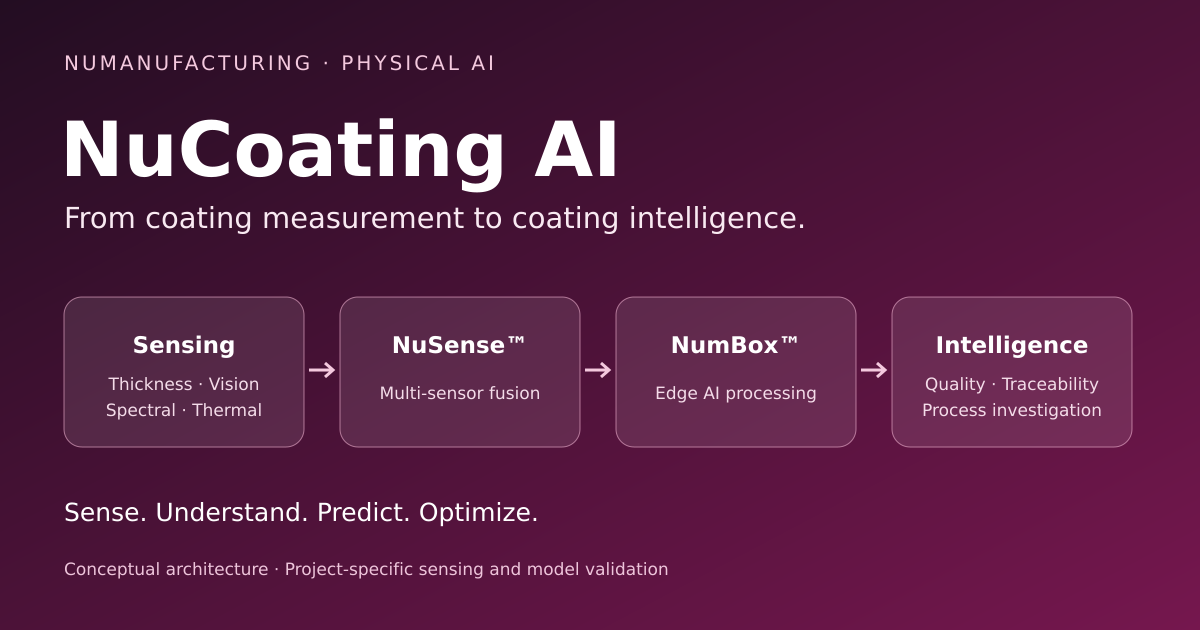
Coating quality is traditionally evaluated after the coating has already been applied. Thickness gauges, visual inspection, laboratory tests and periodic sampling can identify defects—but often only after material, energy and production time have already been consumed.
At Numanufacturing, we believe the next generation of coating quality control should go beyond measurement.
NuCoating AI, powered by the NuSense™ Multi-Sensor Fusion Platform, Edge AI and Physical AI, is designed to transform coating processes into intelligent, continuously monitored manufacturing operations.
From a Single Measurement to Multi-Sensor Understanding
Coating quality cannot always be represented by a single thickness value. The final coating can be influenced by numerous parameters, including:
- Coating thickness and uniformity
- Substrate temperature
- Surface condition
- Application parameters
- Curing temperature and time
- Line speed
- Environmental temperature and humidity
- Material and formulation characteristics
- Equipment condition
- Historical process behaviour
NuSense™ combines information from different sensing technologies and production systems to create a more complete understanding of the coating process.
Depending on the application, this sensor-fusion architecture can integrate non-contact optical coating measurement, thermal sensing, RGB/3D vision, NIR spectroscopy, environmental sensors, PLC signals and other industrial sensors.
Instead of evaluating each sensor independently, AI can analyse their combined behaviour.
NuCoating AI: AI for the Complete Coating Process
NuCoating AI is Numanufacturing's AI-based coating process intelligence platform. The objective is not simply to answer:
“Is the coating thickness within tolerance?”
The system is designed to answer much broader manufacturing questions:
Is the coating process stable? Why is the process moving toward an out-of-spec condition? Where is the problem developing? And what production parameter should be investigated before defective products are produced?
This moves coating inspection toward predictive quality.
1. AI-Based Coating Thickness Intelligence
Non-contact coating measurement technologies can be integrated directly into production lines to inspect selected points or larger surface areas. NuCoating AI can combine these measurements with product identification, geometry and process parameters.
For applications such as automotive wheels, metal components and continuously manufactured products, AI can evaluate thickness distributions and detect deviations from established production patterns.
The objective is not simply an individual μm measurement, but a digital coating-quality profile for each component included in the inspection scope.
2. Computer Vision and Surface Quality
Industrial cameras can provide another layer of information. AI vision models can identify and classify application-specific surface anomalies such as:
- Insufficient coverage
- Excessive coating
- Visible surface defects
- Regional inconsistencies
- Colour or appearance variations
- Recurring defect patterns
Combining vision with coating-thickness information allows NuSense™ to correlate what the camera sees with what the coating measurement system detects. Defect classes and inspection models require suitable examples and validation.
3. NIR Spectroscopy and Material Intelligence
Thickness is only one aspect of coating quality. Through compact NIR spectroscopy and spectral sensing, NuCoating AI can potentially add information about material and chemical characteristics that cannot be obtained from conventional cameras alone.
Depending on the coating material and validated spectral model, this can support analysis of material consistency, formulation variation, curing-related characteristics and incoming-material differences.
Spectral information can then become another input to the NuSense™ sensor-fusion model. These are material- and model-dependent capabilities, not universal chemical measurements.
4. Thermal Intelligence and Curing
Temperature history has a significant relationship with many industrial coating and curing processes. Thermal sensors or cameras can monitor the component before, during or after curing.
NuCoating AI can correlate thermal behaviour with coating measurements, production settings and historical quality results. Instead of defining quality using only a fixed temperature threshold, machine-learning models can identify process signatures associated with accepted and defective reference production.
5. AI-Assisted Formulation and Process Optimization
AI also creates opportunities before the coating reaches the production line. Historical formulation data, laboratory results, raw-material characteristics and final coating properties can be used to develop models supporting formulation development and process optimization.
Rather than replacing chemists and laboratory validation, AI can help engineering teams narrow the experimental space and identify promising relationships between formulations, process conditions and desired coating properties.
The same concept can eventually connect R&D formulation intelligence with real production data. This creates a continuous learning loop:
Formulation → Application → Curing → Inline Inspection → Quality Result → AI Learning → Process Optimization
Edge AI: Intelligence Directly at the Production Line
Industrial AI does not always need to depend on the cloud. NuCoating AI is designed to operate with Numanufacturing's NumBox™ / NumBox II™ Edge AI architecture, allowing sensor data and AI models to be processed close to the production equipment.
This architecture can support:
- Real-time inference
- Low-latency quality decision support
- Local processing of sensitive production data
- Integration with PLC and automation systems
- Operation with limited cloud dependency
- Connection with MES and enterprise platforms
- Continuous production-line monitoring
The result is an architecture designed for real industrial environments rather than an isolated AI dashboard. Interfaces and operating requirements are defined for each project.
Building a Digital Coating Fingerprint
One of the most powerful possibilities of NuCoating AI is the creation of a digital coating fingerprint for each product within the configured inspection scope.
The platform can associate information such as:
Product ID + coating measurements + spectral data + thermal signature + visual inspection + process parameters + environmental conditions + AI quality assessment
Over time, these fingerprints create a valuable manufacturing dataset. AI can then identify patterns that may be extremely difficult to recognise through individual measurements.
A small temperature shift, for example, may not represent a defect by itself. A small thickness variation may also remain within tolerance. But when several subtle changes occur together, NuSense™ can identify a multi-sensor pattern indicating that the process is beginning to drift.
This is where sensor fusion can provide more context than individual sensors.
From Quality Control to Predictive Quality
Traditional quality control asks whether a manufactured product is acceptable. AI-powered coating intelligence introduces another question:
Can we identify the conditions that create the defect before the defect occurs?
By combining production history with real-time sensor data, NuCoating AI is designed to support:
- Early process-drift detection
- Reduced scrap and rework
- More consistent coating quality
- Improved material utilization
- Faster root-cause analysis
- Reduced dependence on manual sampling
- Traceability at product level
- Data-driven process optimization
These benefits are objectives to evaluate in each application, not guaranteed performance or quantified savings. The long-term objective is a coating process that does not simply report quality—but continuously learns how quality is created.
Physical AI for Coating Manufacturing
Numanufacturing defines this approach as part of Physical AI.
Sensors observe the physical manufacturing process. NuSense™ fuses those observations. Edge AI interprets them. NuCoating AI converts them into coating-specific intelligence. The production system can use that intelligence to support operators and quality teams, and eventually support closed-loop process optimization.
Sense. Understand. Predict. Optimize.
Closed-loop process optimization remains a longer-term objective requiring separate engineering and validation; this is not a claim of deployed autonomous control. Sensing configuration, material suitability, calibration, reference measurements, model validation and integration are application-specific.
NuCoating AI by Numanufacturing
AI-Powered Coating Intelligence from Formulation to Production.
Powered by NuSense™ Multi-Sensor Fusion, NumBox™ Edge AI and Numanufacturing Physical AI.